
Help / Guide
Understand a result
Put a signal, reflection or reading in context and decide what to do next.
In the app
What it looks like
Check summary Review device observations Review locations and notes
Example summaries; no findings is not clearance.
Screens show example data, and some may differ slightly from the current version of the app.
STEP 1
Note what you actually observed
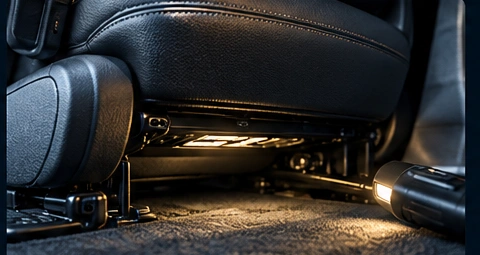
Illustrative photographic example: an accessible under-seat area. Ordinary fittings are not evidence of a tracker.
Read every step
- Note what you actually observed
Current summaries distinguish actual saved Bluetooth observations, connected-network devices, nearby access points, magnetic readings, physical areas, notes, follow-ups, photos, and completed or skipped coverage. Vehicle tabs depend on recorded evidence. The saved variant combines areas, notes and photos in an evidence record; not every design-board tab always appears. Record context without assuming identity or intent.
Expected next state: A factual record of what appeared, where you observed it and what was not checked, without assigning identity or intent.
- Consider ordinary explanations
Consider nearby phones, electronics, metal, lighting and heat before interpreting a result.
Expected next state: You have checked plausible everyday explanations.
- Understand an empty check
Treat no results as “this check showed nothing at this time”, not confirmation that a room or vehicle is clear.
Expected next state: You understand the limits of an empty result.
- Choose a safe next step
If you feel at risk, leave the area. Do not confront someone or handle a suspected device. Consider property management, authorities or qualified technical-security help as appropriate.
Expected next state: You have prioritised safety over trying to prove an observation.
- 1
Note what you actually observed
Illustrative photographic example: an accessible under-seat area. Ordinary fittings are not evidence of a tracker.
Do this. Current summaries distinguish actual saved Bluetooth observations, connected-network devices, nearby access points, magnetic readings, physical areas, notes, follow-ups, photos, and completed or skipped coverage. Vehicle tabs depend on recorded evidence. The saved variant combines areas, notes and photos in an evidence record; not every design-board tab always appears. Record context without assuming identity or intent.
Then you should have. A factual record of what appeared, where you observed it and what was not checked, without assigning identity or intent.
- 2
Consider ordinary explanations

Illustrative photographic example: ordinary bedside electronics. Their appearance does not establish what signals they emit.
Do this. Consider nearby phones, electronics, metal, lighting and heat before interpreting a result.
Then you should have. You have checked plausible everyday explanations.
- 3
Understand an empty check
Illustrative photographic example: an accessible under-seat area. Ordinary fittings are not evidence of a tracker.
Do this. Treat no results as “this check showed nothing at this time”, not confirmation that a room or vehicle is clear.
Then you should have. You understand the limits of an empty result.
- 4
Choose a safe next step

Photographic room example: review accessible visible areas without dismantling anything.
Do this. If you feel at risk, leave the area. Do not confront someone or handle a suspected device. Consider property management, authorities or qualified technical-security help as appropriate.
Then you should have. You have prioritised safety over trying to prove an observation.