
Help / Guide
Bluetooth observations
Understand names, signal strength and repeated observations in any setting.
In the app
What it looks like
Bluetooth observations Bluetooth signal example Room Bluetooth example
Unknown names or strong signals are observations, not proof of surveillance.
Screens show example data, and some may differ slightly from the current version of the app.
STEP 1
Consider ordinary nearby devices
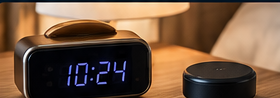
Illustrative photographic example: ordinary bedside electronics. Their appearance does not establish what signals they emit.
Read every step
- Consider ordinary nearby devices
Start with phones, headphones, vehicles and other electronics that may broadcast Bluetooth/BLE signals.
Expected next state: You have a baseline of ordinary explanations.
- Interpret names and strength carefully
Treat missing or unfamiliar names and strong signals as observations. Names can be duplicated or misleading; distance and obstacles affect strength.
Expected next state: You have avoided assigning a device identity from its name or strength.
- Compare observations over time
If your supported tool shows repeated observations, compare place, time and ordinary devices that could also be moving nearby.
Expected next state: You have more context. Repetition alone does not confirm tracking.
- 1
Consider ordinary nearby devices
Illustrative photographic example: ordinary bedside electronics. Their appearance does not establish what signals they emit.
Do this. Start with phones, headphones, vehicles and other electronics that may broadcast Bluetooth/BLE signals.
Then you should have. You have a baseline of ordinary explanations.
- 2
Interpret names and strength carefully
Illustrative photographic example: ordinary bedside electronics. Their appearance does not establish what signals they emit.
Do this. Treat missing or unfamiliar names and strong signals as observations. Names can be duplicated or misleading; distance and obstacles affect strength.
Then you should have. You have avoided assigning a device identity from its name or strength.
- 3
Compare observations over time
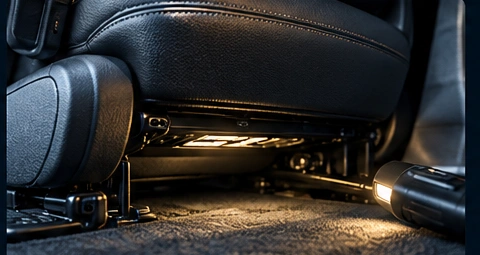
Illustrative photographic example: an accessible under-seat area. Ordinary fittings are not evidence of a tracker.
Do this. If your supported tool shows repeated observations, compare place, time and ordinary devices that could also be moving nearby.
Then you should have. You have more context. Repetition alone does not confirm tracking.